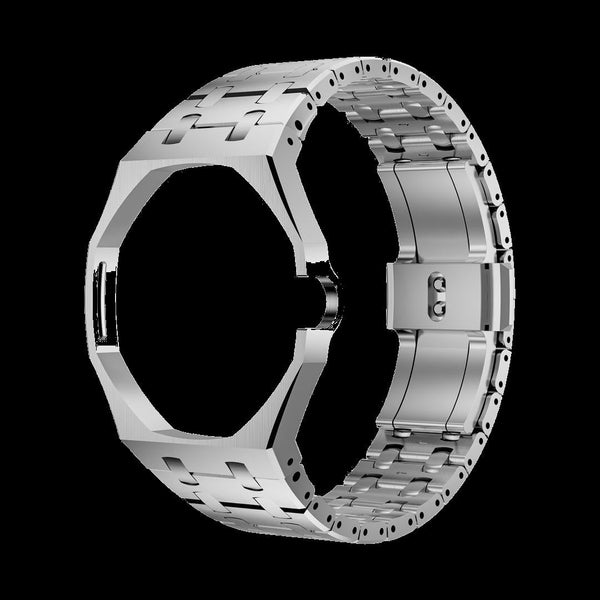
Bioceramic: The Material Built Into the Royal Pop 40mm
The Royal Pop 40mm was designed around a specific material: bioceramic. Not stainless steel. Not titanium. Not resin. Bioceramic was chosen by Swatch and Audemars Piguet as the defining material of the Royal Pop 40mm — the substance that gives the watch its weight, its surface quality, its matte-to-satin finish, and its unique tactile identity.
When Royal Pop Style set out to create the best possible bracelets for the Royal Pop 40mm, the answer was straightforward: the bracelet needed to be bioceramic too. Any other material creates a visible and tactile discontinuity between case and bracelet. Bioceramic creates continuity.
This article explains the science behind that choice — what bioceramic is, how it performs, how it compares to every alternative, and why it is the most technically correct bracelet material for the Royal Pop 40mm.
What Is Bioceramic? The Material Science
Bioceramic is a composite material developed originally for biomedical applications — bone implants, dental prosthetics, and surgical instruments — where materials needed to be extremely hard, chemically inert, and biocompatible. Its adoption into premium watchmaking came from recognizing that the same properties that make it ideal for medical use also make it extraordinary as a case and bracelet material.
The composition combines:
- Ceramic powder (zirconia or alumina-based) — provides hardness, chemical resistance, and the characteristic surface finish. Zirconia-based bioceramic reaches 8.5–9 on the Mohs hardness scale.
- Bio-sourced polymer binder — provides formability, impact resistance, and weight reduction. Without the binder, pure ceramic would be too brittle for wrist wear. The binder transforms it into a practical material that can be precisely molded.
The resulting material is simultaneously harder than steel, lighter than titanium, chemically inert, hypoallergenic, and capable of holding tight dimensional tolerances — making it technically superior to every traditional bracelet material for the Royal Pop 40mm application.
Bioceramic vs Six Alternative Bracelet Materials
1. Bioceramic vs Stainless Steel
Steel rates 5.5–6.5 on the Mohs scale — significantly softer than bioceramic. Steel bracelets scratch visibly from keys, buckles, and desk contact. Bioceramic does not. Steel is also heavier, adding meaningful wrist weight. Steel bracelets can trigger nickel allergies in sensitive wearers. Bioceramic is hypoallergenic. On a bioceramic watch case, a steel bracelet creates immediate material discontinuity — it looks like a mismatched accessory.
2. Bioceramic vs Titanium
Titanium (grade 5) rates approximately 6 on the Mohs scale — better than steel but still meaningfully softer than bioceramic. Titanium is lighter than steel and hypoallergenic, which gives it advantages over steel. But it scratches from daily use and requires periodic brushing to maintain its finish. On the Royal Pop 40mm, a titanium bracelet creates the same material discontinuity as steel.
3. Bioceramic vs Standard Silicone
Standard silicone is soft, flexible, and comfortable. But it degrades under UV exposure (yellowing and stiffening), absorbs odors over time, and creates a strong visual contrast with the bioceramic case of the Royal Pop 40mm that reads as downmarket. premium silicone (the Royal Pop Style Silicone/Bioceramic line) overcomes the UV and odor issues — but even premium silicone reads differently against a bioceramic case than bioceramic does.
4. Bioceramic vs Rubber
Similar to silicone: rubber bracelets are comfortable and practical for sport but create an immediate aesthetic discontinuity with the Royal Pop 40mm's case. They also age visibly — cracking, hardening, or discoloring with extended use.
5. Bioceramic vs Leather
Leather on the Royal Pop 40mm is an interesting aesthetic choice — it creates deliberate contrast and a more traditional watch character. But leather has real practical limitations: it absorbs sweat, water exposure degrades it, it cannot be cleaned easily, and it ages visibly in a way that bioceramic does not. It also has no material connection to the Royal Pop 40mm's design DNA.
6. Bioceramic vs Nylon / NATO
Nylon NATO straps are casual, colorful, and highly practical — but they create the maximum visual contrast with the Royal Pop 40mm case and read as a deliberately casual styling choice rather than a premium one. NATO straps have their place, but they do not complement the Royal Pop 40mm's bioceramic aesthetic.
The Matching-Aesthetic Argument
The strongest argument for bioceramic bracelets on the Royal Pop 40mm is not technical — it is aesthetic. The watch was designed as a bioceramic object. Its case, its dial architecture, its entire visual identity is built around the specific matte-to-satin quality, the precise weight, and the characteristic surface of bioceramic.
A Royal Pop Style bioceramic bracelet extends that identity. The transition between case and bracelet is seamless — same material behavior under light, same tactile response under touch, same weight per volume. The watch looks complete.
Every other material creates a visible join — a moment where the bracelet begins and the watch ends. Bioceramic eliminates that join.

Long-Term Performance: What Happens After 3 Years of Daily Wear
Bioceramic's most distinctive property for long-term ownership is color permanence. Unlike surface-coated materials (PVD-coated steel, anodized aluminum, painted rubber), bioceramic color is structural — it exists throughout the material, not just at its surface. This means:
- Color cannot be scratched away — because it exists in the same material that resists scratching
- Color cannot peel — because it is not a coating
- Color cannot fade from UV — bioceramic is UV-stable
- Color cannot fade from sweat — bioceramic is chemically inert
A Royal Pop Style bioceramic bracelet purchased today will have the same color depth and uniformity in three years as it did on day one. The same cannot be said for PVD-coated steel (chips at edges), anodized aluminum (fades), or painted rubber (peels).
Royal Pop Style Bioceramic Collections
- Bioceramic Monochrome — 8 solid colorways, from €139. Everyday versatility.
- Bioceramic Dual — 5 two-tone combinations, from €145. Bold self-expression.
Both collections: guaranteed fit for the Royal Pop 40mm, free shipping across Europe, 30-day full refund.
Bioceramic Collection
The Material That Belongs on Your Royal Pop 40mm
Ten monochrome bioceramic colorways engineered to match the Royal Pop 40mm's factory materials — in every finish, from every angle. From €139.
Shop Bioceramic →Frequently Asked Questions
Is the Royal Pop Style bracelet made of real bioceramic?
Yes. Royal Pop Style uses a premium bioceramic composite — ceramic powder combined with a high-grade polymer binder — chosen to complement the look and feel of the Royal Pop 40mm. It is an independent aftermarket accessory, not an original part.
Can bioceramic shatter if dropped?
Pure ceramic can shatter from sharp impacts. Bioceramic's polymer binder adds impact resistance that pure ceramic lacks. That said, extreme impact (dropping on hard stone) can cause damage, as with any watch accessory material. Normal daily use presents no risk.
Does bioceramic conduct heat or cold?
Bioceramic has low thermal conductivity — it does not become uncomfortably hot in summer or cold in winter, unlike metal bracelets.
Is bioceramic safe for sensitive skin?
Yes. Bioceramic is hypoallergenic and contains no nickel or known allergens. It is one of the most skin-compatible bracelet materials available.
Shop Bioceramic Bracelets — From €139 →
Legal notice: Royal Pop Style is an independent accessories brand and is not affiliated with, endorsed by, or associated with Swatch Group Ltd or Audemars Piguet & Cie SA. «Swatch», «Audemars Piguet» and «Royal Oak» are registered trademarks of their respective owners. All Royal Pop Style products are premium aftermarket accessories designed to be compatible with the Royal Pop 40mm watch.
The Royal Pop 40mm: Essential Technical Context
The Royal Pop 40mm is built around a 40mm octagonal case with a proprietary quick-release spring bar system engineered for tool-free bracelet swaps in under 30 seconds. The case material — premium bioceramic — is a composite of approximately 70% aluminium-oxide ceramic powder and 30% high-performance polymer binder. This gives the material a Mohs hardness of 7–8: significantly more scratch-resistant than stainless steel (4–4.5 Mohs) and roughly 50% lighter than an equivalent steel component.
Royal Pop Style bracelets are machined to match the Royal Pop's exact geometry, with levers engineered to engage the integrated lug system without adapters or shims. Three material families cover the full range of use cases:
- Bioceramic Monochrome — a premium ceramic-polymer composite, available in 10 solid colourways (Black, White, Green, Light Blue, Pink, Red, Yellow, Dark Blue, Light Pink, Light Green) from €139. Scratch-resistant, hypoallergenic, and virtually weightless on the wrist.
- Bioceramic Dual — two contrasting bioceramic colours in a single bracelet, 5 exclusive two-tone combinations from €145. No equivalent exists in the official catalogue.
- Silicone/Bioceramic — premium silicone body paired with a bioceramic clasp. Waterproof, sweat-proof, UV-stable, and rated for sport use. 10 colourways from €119, plus a 3-combination Silicone Dual line from €125.
Every order ships worldwide free of charge, processed within 24–48 hours from Belgium. All bracelets include a 30-day no-questions return policy and a full 2-year EU legal product guarantee. Royal Pop Style is an independent accessories brand operated by Brahim Korkdan (VAT: BE0869.820.081) — not affiliated with Swatch Group SA or Audemars Piguet SA.
Bioceramic is classified as an advanced technical ceramic — a family of materials that includes zirconia (used in dental implants), silicon carbide (used in aerospace), and alumina (used here). The polymer binder in Swatch's formulation acts as a plasticiser during injection moulding, allowing complex shapes to be formed before sintering at high temperature. The resulting material is non-porous, non-reactive, and impervious to sweat, chlorine, and UV radiation. Unlike metal, bioceramic does not conduct heat, meaning it reaches skin temperature within seconds of being worn and never feels cold in winter or burns in direct summer sun.